/
/
Game Sense
Game Sense
Why You Are Not Improving at CS2 (And the System That Fixes It)
Hours do not make you better — structure does. Here is the six-layer system CS2 players actually improve with, in the order that makes it work.
WHAT YOU’LL LEARN
You have the hours. You have watched the videos. You warm up. You still lose to people who play less than you.
That is not a skill problem. It is a structure problem, and almost nobody explains it, because "practise more" is easier to say and sells more boosts.
Here is what is actually happening, and the system that fixes it.
PRACTICE WITHOUT ORDER IS JUST REPETITION
Most CS2 players improve the same way: they play, they notice something they are bad at, they watch a video about it, they try it for two days, then something else goes wrong and they chase that instead.
That is not training. That is reacting.
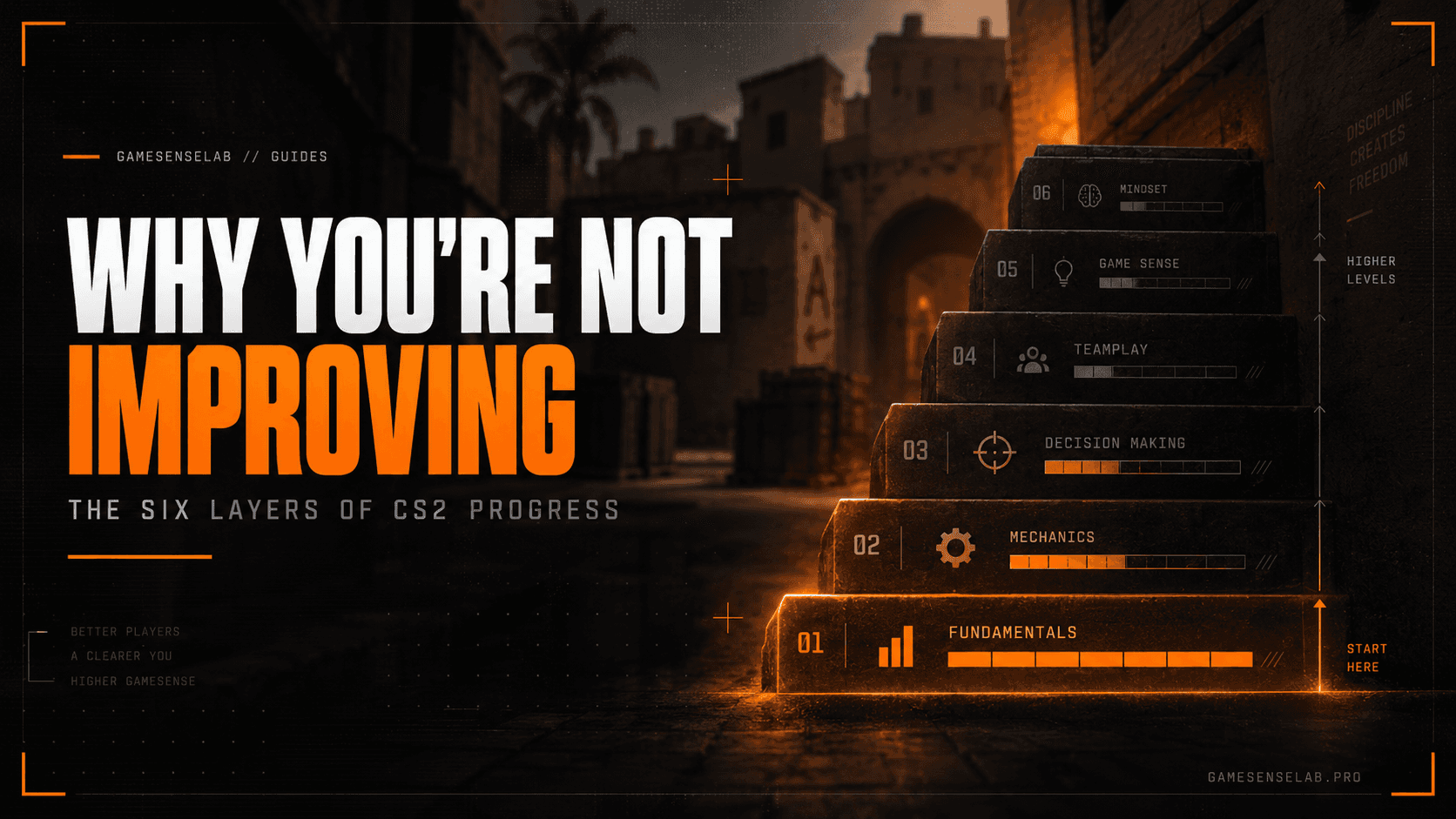
Improvement in Counter-Strike is layered, and the layers only work in order. Utility knowledge does nothing if you die before you throw it. Map knowledge does nothing if you cannot hold the angle it tells you to hold. Decision-making does nothing if your hands cannot execute the decision.
Most players are stuck because they are working on layer 4 while their problem is on layer 1 — or worse, grinding layer 1 forever when they cleared it six months ago.
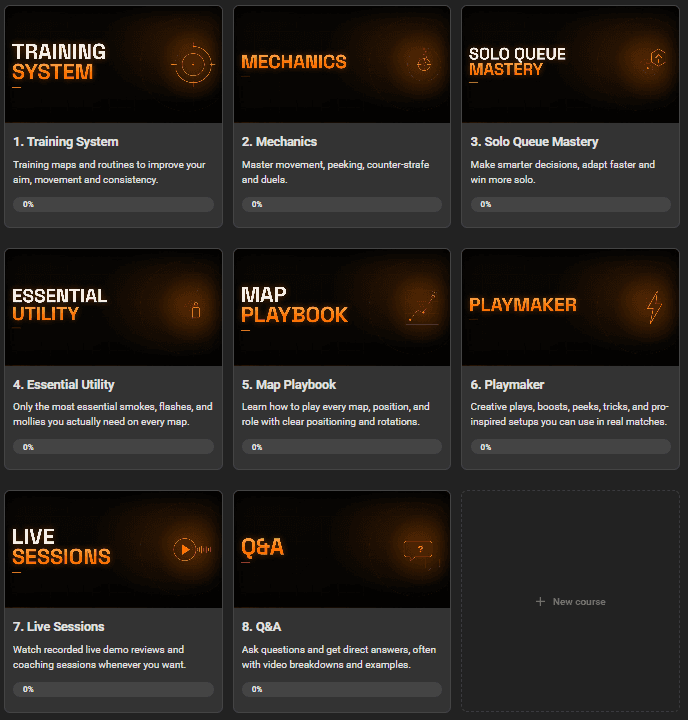
The full system, in the order it works.
LAYER 1 — MECHANICS
What it is. Movement, counter-strafing, peeking, spray control, first-bullet accuracy. The physical ability to win a fight you have already decided to take.
How to know it is your bottleneck. You lose duels you had every information advantage in. You know where the enemy is, you peek first, and you still die. If you are losing fights you should mechanically win, nothing above this layer matters yet.
What to do. Ten focused minutes before every session, not forty. Specific maps for specific weaknesses, not aim_botz on autopilot. The five best CS2 training maps are here, and they cover every mechanical gap worth training.
The mistake. Staying here forever because it is the only layer that gives you a number back. Mechanics are comfortable to practise. That does not make them your problem.

Layer 1 broken into lessons instead of a vague "practise aim".
LAYER 2 — A ROUTINE YOU ACTUALLY REPEAT
What it is. The same practice, on a schedule, long enough to change something.
How to know it is your bottleneck. You know what to practise. You just do not do it consistently. Some weeks you train four times, some weeks not at all, and you cannot tell whether anything is working because nothing ran long enough to measure.
What to do. Pick three sessions a week and make them identical. Same warm-up, same focus, same length. Boring on purpose. A routine you follow at 60% effort beats a perfect routine you abandon in nine days.
The mistake. Redesigning the routine every time you see a new video. The routine is not the variable. Your adherence to it is.
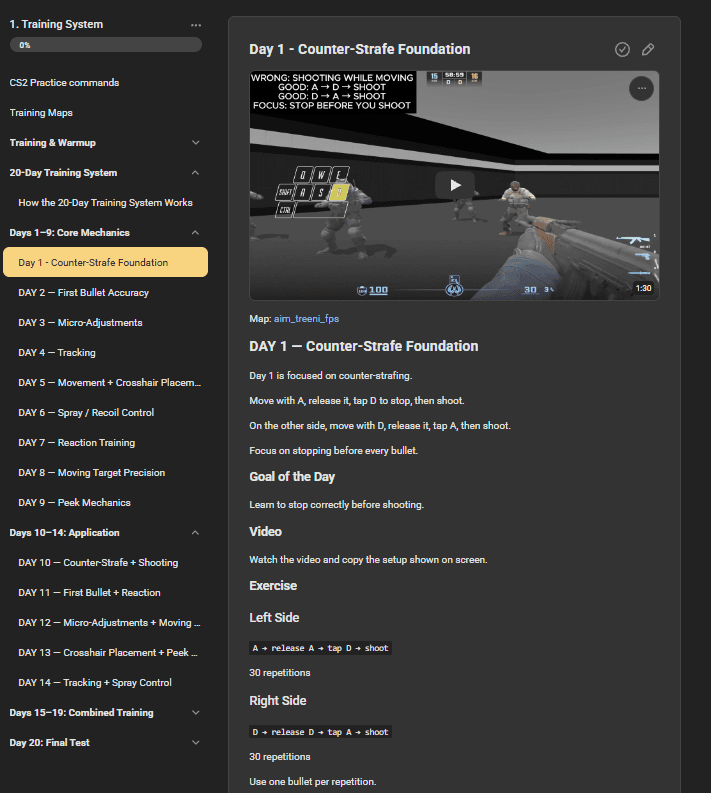
The routine, written down, so you stop rebuilding it every week.
LAYER 3 — UTILITY THAT YOU ACTUALLY USE
What it is. The smokes, flashes and mollies that decide rounds on the maps you play — not all 200 of them, the twelve that matter.
How to know it is your bottleneck. You die holding utility. You watch a teammate open a site with one flash and realise you had the same flash and never threw it.
What to do. Learn four per map: one smoke that blocks the most dangerous angle, one flash for the most common entry, one molly for the most common hiding spot, one for retakes. Four, not forty. You will use four.
There is no shortage of lineup content on YouTube, and that is the problem. The work is not finding lineups, it is deciding which ones are worth the hour it takes to learn them. So this module is a filter, not a library: for each map, the specific lineups that change rounds at your rank, and the clearest existing video for each one, so you are not watching a 40-minute upload to get three useful throws.
The mistake. Bookmarking a 90-lineup video and learning none of them. Volume is why people give up on utility.
LAYER 4 — MAP KNOWLEDGE AND A ROLE
What it is. Knowing where to stand, when to rotate, and what your job is on each side of each map.
How to know it is your bottleneck. You are mechanically fine, you have utility, and you still feel lost — always in the wrong place, always arriving after the fight, never sure whether to rotate.
What to do. Pick two maps and learn them properly instead of playing nine badly. Inside each, pick one role per side and play it every match. Depth beats coverage at every rank below Level 8.
The mistake. Treating map knowledge as callouts. Callouts are vocabulary. Knowing that Short is contested at 0:35 and that a lost mid means B is next — that is map knowledge.
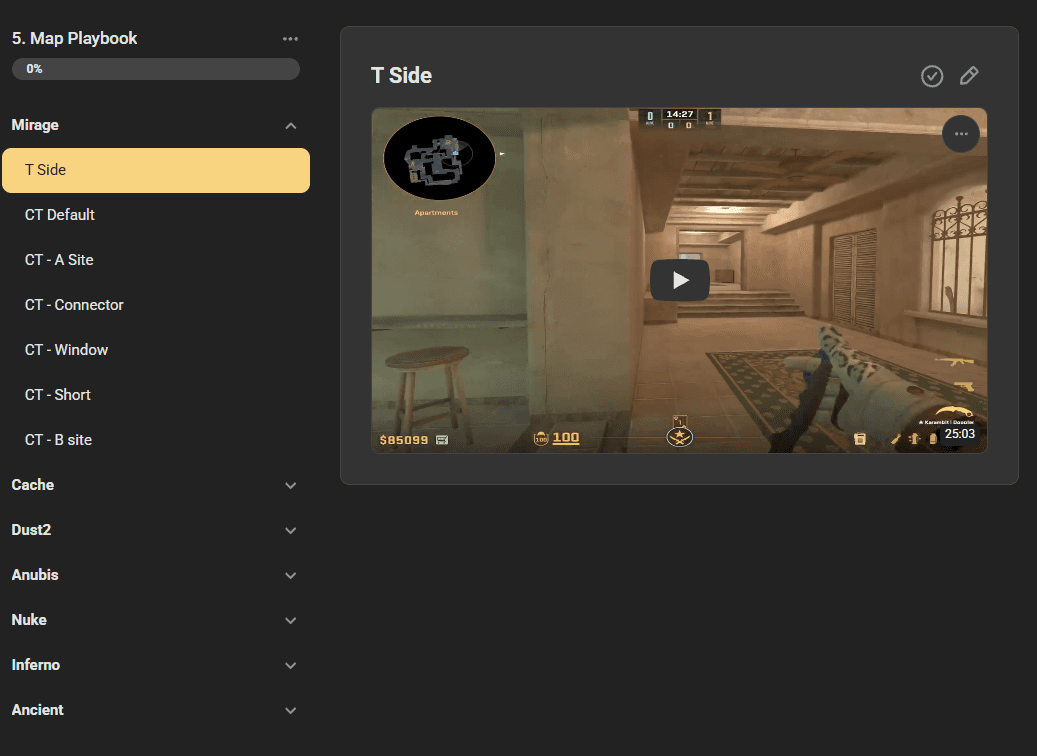
Every map, every position, every rotation — written out.
LAYER 5 — DECISIONS UNDER PRESSURE
What it is. Choosing the right fight, at the right time, with the right information — especially alone, with four strangers who will not help you.
How to know it is your bottleneck. Your stats look fine and you still lose. You win your duels and lose your rounds. You are the player who dies last, with the bomb, in a 1v3 that was a 3v3 forty seconds ago.
This is also where most players stuck at FACEIT Level 5 are stuck, and why more hours do not move them.
What to do. This is the layer you cannot fix by playing more, because you cannot see your own decisions while you are making them. You have to watch them back. Seven habits quietly cost most players rounds here, and none of them show up on the scoreboard.
The mistake. Assuming this layer is talent. It is not. It is pattern recognition, and patterns are learnable — but only from footage.
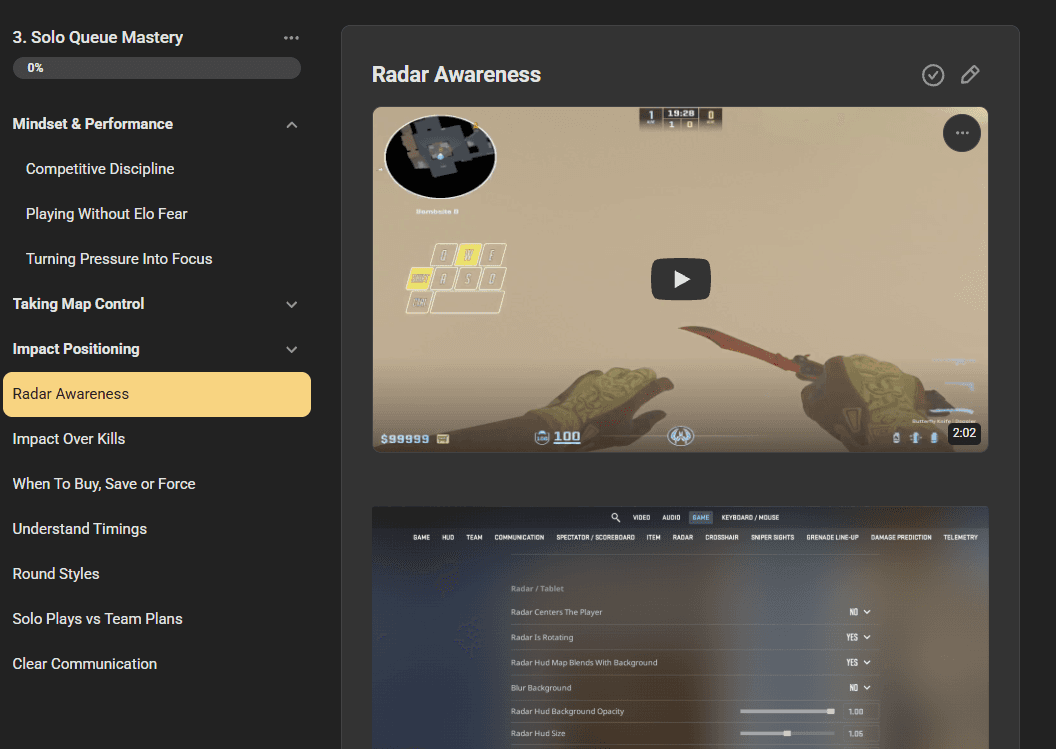
The layer that separates Level 5 from Level 8.
LAYER 6 — SOMEONE WHO TELLS YOU THE TRUTH
What it is. Feedback. An outside view of your gameplay from someone who has no reason to be nice about it.
How to know it is your bottleneck. You have worked on all five layers above and you are still not sure which one is actually broken. You have been guessing for months.
What to do. Start with your own demos — here is the twenty-minute routine that turns one match into one fixable habit. It works, and it is free. But you are still the person judging your own decisions, which has a ceiling.
Past that ceiling, you need someone else watching. That is what live demo reviews and a question you can actually ask are for.
The mistake. Skipping this layer because it feels like admitting you need help. Every player above Level 9 has had someone watch their gameplay and tell them something they did not want to hear.
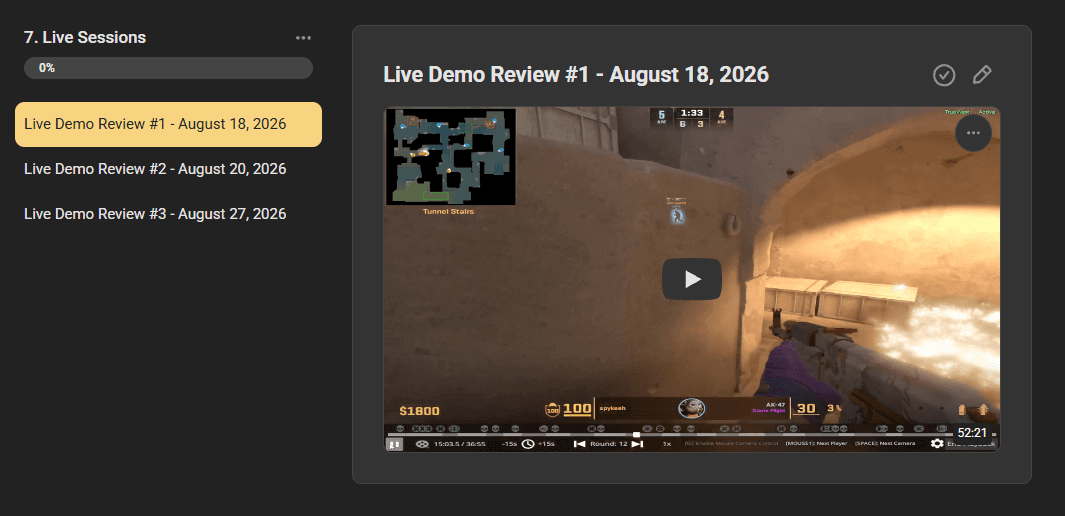
Recorded demo reviews you can watch whenever you want.
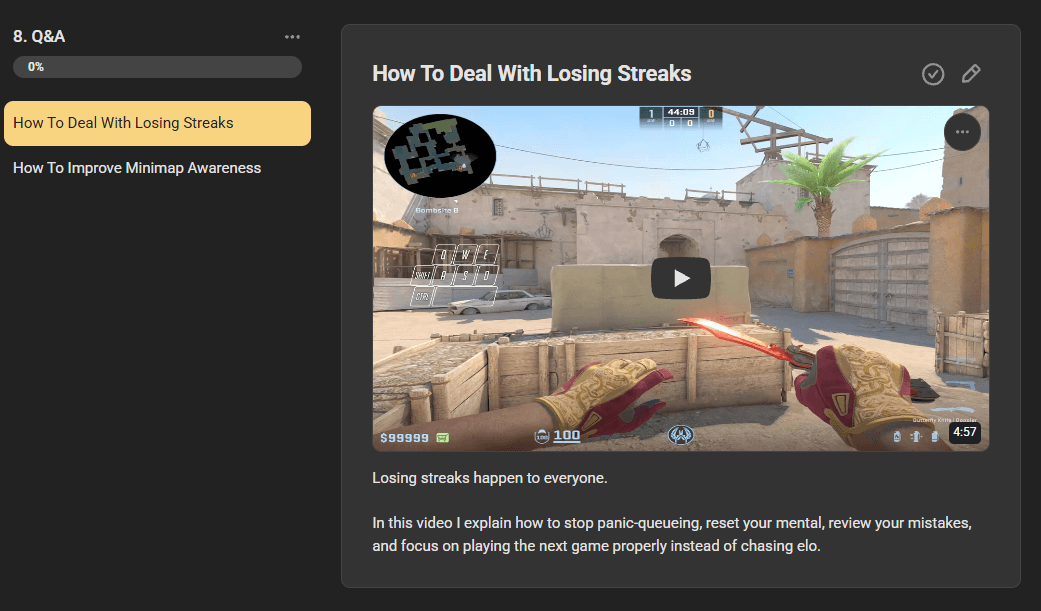
Ask, get an actual answer, often with a video breakdown.
WHY THE ORDER MATTERS MORE THAN THE CONTENT
Everything above is available for free somewhere on the internet. That is not the problem and never was.
The problem is that free content arrives in random order, from people with different opinions, aimed at players at every rank at once. You get a 4000-elo player's advice about lurking while your actual problem is that you cannot counter-strafe, and you cannot tell the difference because nobody labelled it.
A system is not better information. It is the same information, sequenced, so you always know what you are working on and what comes next.
That is the entire difference between two thousand hours that make you better and two thousand hours that make you the same player with more hours.
HOW LONG THIS TAKES
One layer at a time, three to four weeks each, is realistic for someone playing a few times a week. Six layers, roughly six months, if you are honest about which one you are on.
You will not do it in the order written if you are already past layer one. Most players stuck between Level 4 and Level 7 are somewhere in layers 3 to 5, and the first useful thing they do is stop working on layer 1.
Six months sounds slow. It is faster than the four years most people spend cycling randomly through all six.
DO IT FREE, OR DO IT WITH THE SYSTEM
Everything in this article works on your own. The guides on this site cover a good part of it and cost nothing, and you should start there today rather than waiting for a perfect setup.
The Rank Up Society exists for the part that does not work on your own: the sequencing, the recorded demo reviews, the answer when you are stuck at 11pm, and the people who are two levels above you and remember being exactly where you are.
Eight modules, in the order above. Live sessions you can rewatch. A question you can ask and get answered. Five dollars a month, cancel whenever.
If you are going to spend another six months on this game either way, the only real question is whether those six months are structured.
WHERE TO ACTUALLY JOIN
The Rank Up Society is hosted on Skool. Everything shown in the screenshots above lives there: the eight modules in order, the recorded live sessions, and the Q&A channel where you can ask about your own situation.
It costs five dollars a month and you can cancel any time. Join the CS2 Rank Up Society here.
If you are not ready to pay for anything, the Discord is free and the questions channel is open. Join the Discord here.

Brian Sirbu
CS2 COACH // GAMESENSELAB
MORE CS2 GUIDES


