/
/
Utility
Utility
CS2 Utility: Lineups Are Not Your Problem
You do not lose rounds because your smoke landed two metres off. You lose them because nobody moved when it landed. The timing side of CS2 utility.
WHAT YOU’LL LEARN

Every utility guide starts the same way. Here is a lineup for Mirage. Here is a lineup for Inferno. Stand on this pixel, aim at that pixel, jump-throw.
Then you learn twelve of them, you hit them perfectly, and you still lose the round.
I coach players between FACEIT Level 4 and Level 8. Almost none of them have a lineup problem. What they have is a timing problem, a communication problem, and a habit of dying with two flashes still in the bag. Lineups are the last ten percent of utility. This guide is the first ninety.
FOUR SLOTS AND ELEVEN HUNDRED DOLLARS
You can carry four grenades. Maximum two flashes, and one of everything else. The standard competitive set — one smoke, two flashes, one molotov — already fills every slot, so every buy is a choice about what you are not bringing.
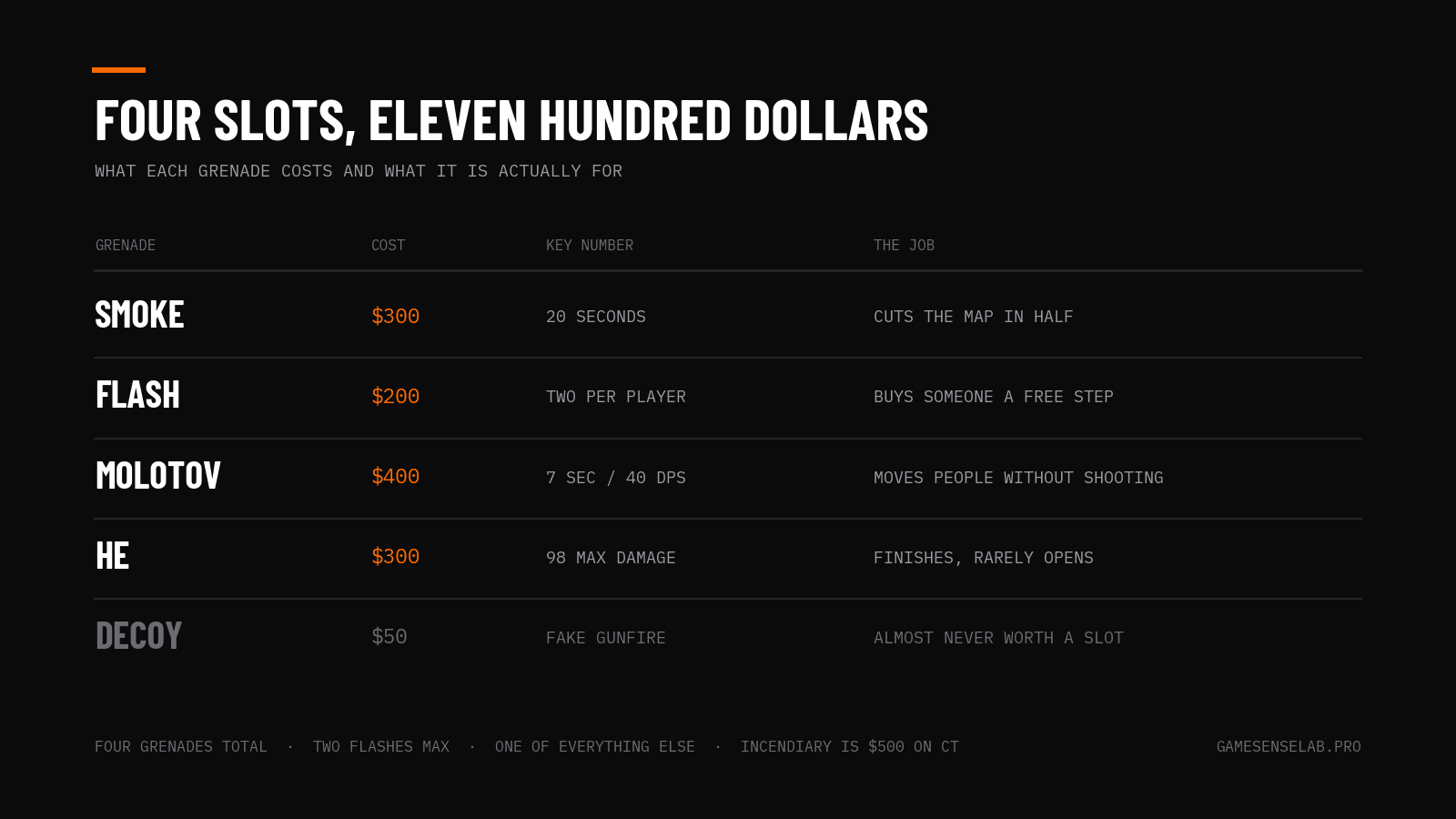
Four grenades, and you have already spent them before the round starts.
Eleven hundred dollars is close to half a rifle. You would never buy an AK and then die without firing it, but players do exactly that with utility every single round. Dying with a full kit is not being careful. It is wasting eleven hundred dollars.
THE ONLY QUESTION THAT MATTERS
Before any grenade leaves your hand, there is one question: what moves behind it?
A smoke that nobody walks through is three hundred dollars of nothing. A flash that pops while your whole team is still holding an angle is two hundred dollars of nothing. Utility is not a thing you spend. It is a down payment on movement — yours or a teammate's — and if no movement follows, you did not use it, you threw it away.
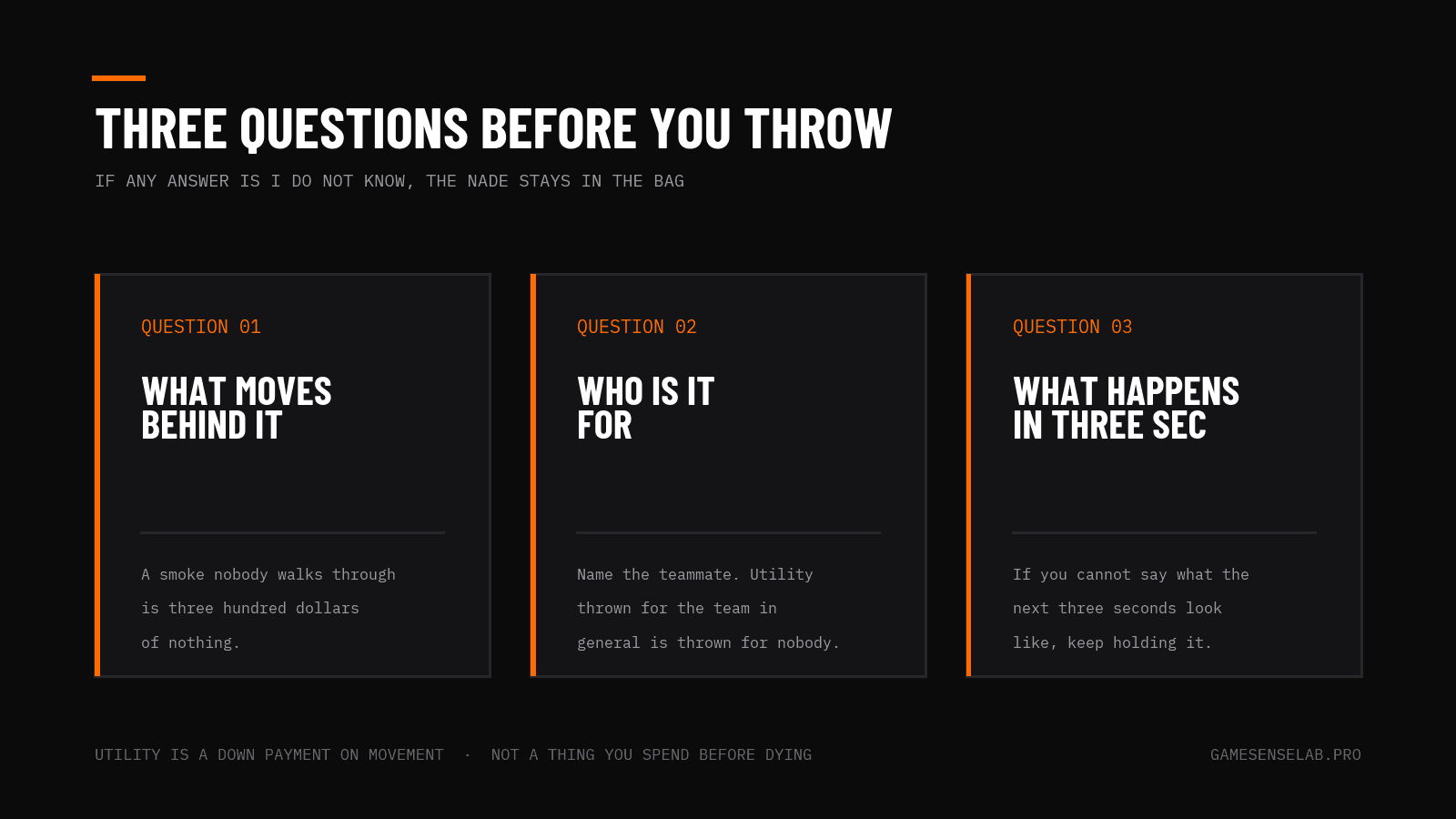
If any answer is I do not know, the nade stays in the bag.
This is why "I smoked for you" is not a call. "Smoke is landing in two, take Short on it" is a call. One of them makes something happen.
SMOKES
A CS2 smoke lasts about twenty seconds and it is volumetric, which means it fills the space it is thrown into rather than sitting there as a flat sphere. It also reacts to the world: bullets punch temporary holes through it, and an HE grenade blows a gap in it entirely.
That second part changes how you should think about smokes. A smoke is not a wall you get to hide behind. It is a twenty-second window where the enemy has to guess, and it can be opened up by anyone with three hundred dollars and a bit of sense.
Three jobs a smoke actually does.
It cuts the map in half. One smoke in the right choke removes an entire angle from the round, which is worth more than any smoke thrown at a person.
It isolates a fight. If you are taking a site and there are three angles, smoking two of them turns a 1v3 into a 1v1 you can actually win.
It buys time. On CT side, a smoke in the choke does not need to stop the push. It only needs to slow it long enough for the rotation to arrive.
What a smoke does not do: kill anybody, or protect you while you stand still inside it listening.
FLASHES
You carry two flashes for a reason. Flashes are the cheapest utility in the game at two hundred dollars, and they are the only grenade that directly wins a duel that was already happening.
The rule is simple: you flash for someone, not at someone.
A flash thrown at an enemy with nobody following it gives them a second of inconvenience. A flash thrown for a teammate who is already moving gives them a free step into an angle. Same grenade, completely different round.
Two things to fix immediately.
Turn away from your own flash. If you are blinding yourself half the time, you are not using two hundred dollars, you are paying two hundred dollars to be useless for a second.
Move within one second of it popping. If you flash and then think about whether to peek, the flash is already over by the time you decide. The decision comes first, the flash second.
The pop flash — thrown over an object so it detonates before anyone sees it — is worth learning on the two or three maps you actually play. That is a lineup worth having. Thirty of them are not.
MOLOTOVS
The most undervalued grenade in the game, and the one that separates a Level 5 from a Level 8 faster than anything else.
A molotov costs four hundred dollars on T side, five hundred as an incendiary on CT, burns for about seven seconds and does around forty damage per second to anyone standing in it.
It almost never kills. That is not the point. A molotov moves a person out of a position without you having to peek them, and it buys you seven seconds of that space being unusable.
Where it wins rounds.
It clears a corner you do not want to check with your body.
It stops a push at a choke and forces the whole team to either eat damage or wait, which is the same as waiting.
It denies a defuse. A molotov on a planted bomb is the cheapest way to turn a lost post-plant into a won one.
It flushes someone out of a pit or a corner in a retake, so the fight happens on your terms instead of theirs.
HE GRENADES
An HE does up to ninety-eight damage to an unarmoured player and around fifty-seven to an armoured one. In practice that means it almost never kills anyone who bought armour, which in a real round is everyone.
So stop using HE to open fights. Use it for three things instead: finishing a player you already damaged, blowing a hole in a smoke to catch somebody who thinks they are safe, and hitting a stacked group in a post-plant where fifty-seven damage each turns three healthy players into three players who cannot take a duel.
The decoy, at fifty dollars, is worth mentioning only to say this: it takes a slot you could have given to a flash. It almost never earns it.
FIVE MISTAKES THAT COST YOU ROUNDS
Throwing before anyone is ready. The smoke lands, everybody looks at it, nobody moves, it expires. This is the single most common utility mistake below Level 10.
Everyone smoking the same choke. Four smokes in one place is not four times the coverage. It is one smoke and three wasted buys.
Saving it for later. There is no later. If you die with utility, that utility never existed. Use it while it can still change something.
Flashing your own team. Call it. Two words — "flashing left" — turns a team-blind into a coordinated entry.
Buying a full kit on a thin round. If the kit means someone on your team is going in with a pistol, the kit was the wrong buy.
HOW TO PRACTICE WITHOUT GRINDING LINEUPS
Pick the two maps you actually queue. On each one, learn three lineups. Not thirty.
One smoke that cuts the main choke on T side.
One molotov that clears the most common CT hiding spot on the site you hit most.
One pop flash for your standard entry.
That is six lineups total, and they will cover the overwhelming majority of rounds you play. Practise them in an offline server with sv_grenade_trajectory_prac 1 and sv_infinite_ammo 1, ten minutes, until you can throw them without thinking.
One note on binds: CS2 has no built-in jump-throw bind, and Valve restricted the old multi-action bind scripts in 2024. The manual version — hold the throw, jump, release at the top — is consistent now because of CS2's sub-tick input. Learn it manually and you are not dependent on a config that might break next update.
Which two maps you pick matters more than how many lineups you own.
WHERE UTILITY FITS
Utility is the layer between mechanics and game sense. It does not fix your aim, and it does not tell you which site to hit. What it does is make the round easier before the first bullet is fired.
If you are already stopped when you shoot and you are still losing the same rounds, utility timing is usually the next thing that is broken. Here is how the layers stack, and where utility sits between them.

Brian Sirbu
CS2 COACH // GAMESENSELAB
MORE CS2 GUIDES


