/
/
Maps
Maps
CS2 Maps: Stop Trying to Learn All Seven
The Active Duty pool has seven maps. You need two. Which two to pick, what knowing a map actually means, and why callouts are not it.
WHAT YOU’LL LEARN

Ask a Level 5 player which maps he plays and he will say "all of them". Ask him what a CT does on Mirage when mid is lost and he will not have an answer for any of them.
That is the whole problem with how map knowledge gets taught. Every guide is either a ranked list of the seven maps or a wall of forty callouts per map. Both are the same mistake in different clothes: they treat map knowledge as a vocabulary test.
It is not. And you are not going to learn seven maps, because professional teams with coaches and full-time schedules only properly play three or four.
THE SEVEN MAPS, AND THE MATH THAT KILLS YOU
The current Active Duty pool is Ancient, Anubis, Cache, Dust 2, Inferno, Mirage and Nuke. Cache came back in July 2026, replacing Overpass, and the pool rotates roughly every six months.
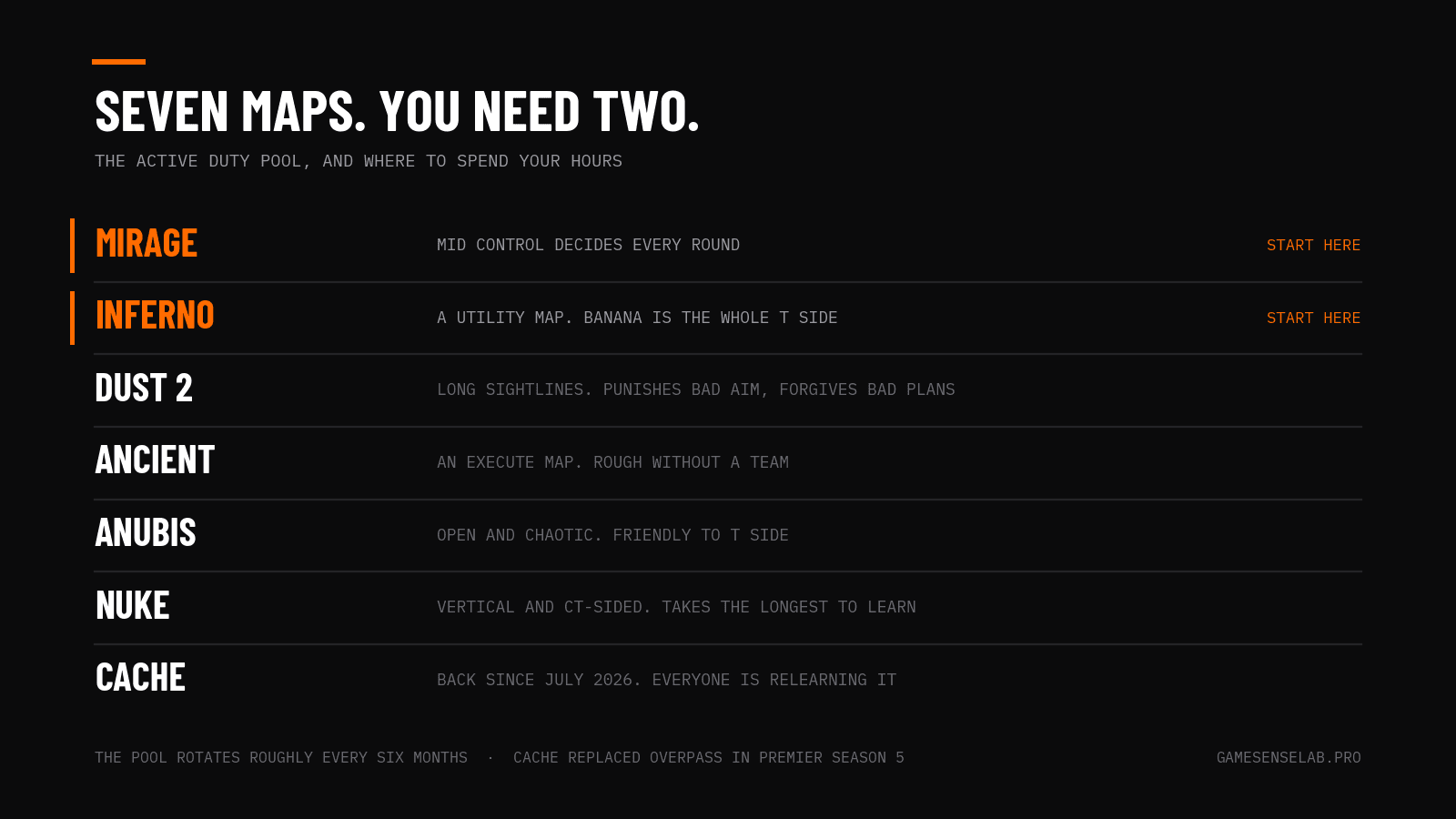
Seven maps, two sides each, and the pool changes twice a year.
Do the arithmetic on "learn all of them". Seven maps, two sides each, four or five roles per side, a set of utility per role, and the timings that tie it together. That is somewhere north of seventy separate things to know, on a pool that partially resets every six months.
Meanwhile the player who knows Mirage and Inferno properly beats you on Mirage and Inferno, and bans the rest.
PICK TWO
If you are below FACEIT Level 8, pick two maps and give them ninety percent of your queue time.
Mirage and Inferno is the default answer, and it is the right one for most players. Mirage teaches you map control — mid decides the round, and learning that teaches you how every map works. Inferno teaches you utility, because Banana is basically an argument settled with molotovs and smokes. Between them you cover the two skills that transfer everywhere else.
If you are brand new and Inferno feels overwhelming, Mirage and Dust 2 is a softer start. Dust 2 has long sightlines and few moving parts, so your mistakes are visible and fixable.
One note worth knowing: Cache is the most interesting map in the pool right now, because it came back recently and nobody's knowledge of it is settled. Everybody is relearning it at the same time, which means the usual gap between you and a better player is smaller there than anywhere else. If you want an edge rather than a comfortable start, that is where it is.
WHAT KNOWING A MAP ACTUALLY MEANS
Callouts are vocabulary. Useful, learn them in a day, but knowing that a spot is called Jungle does not tell you anything about whether to check it.
Knowing a map is three layers, and you can build all three on one map in a week.
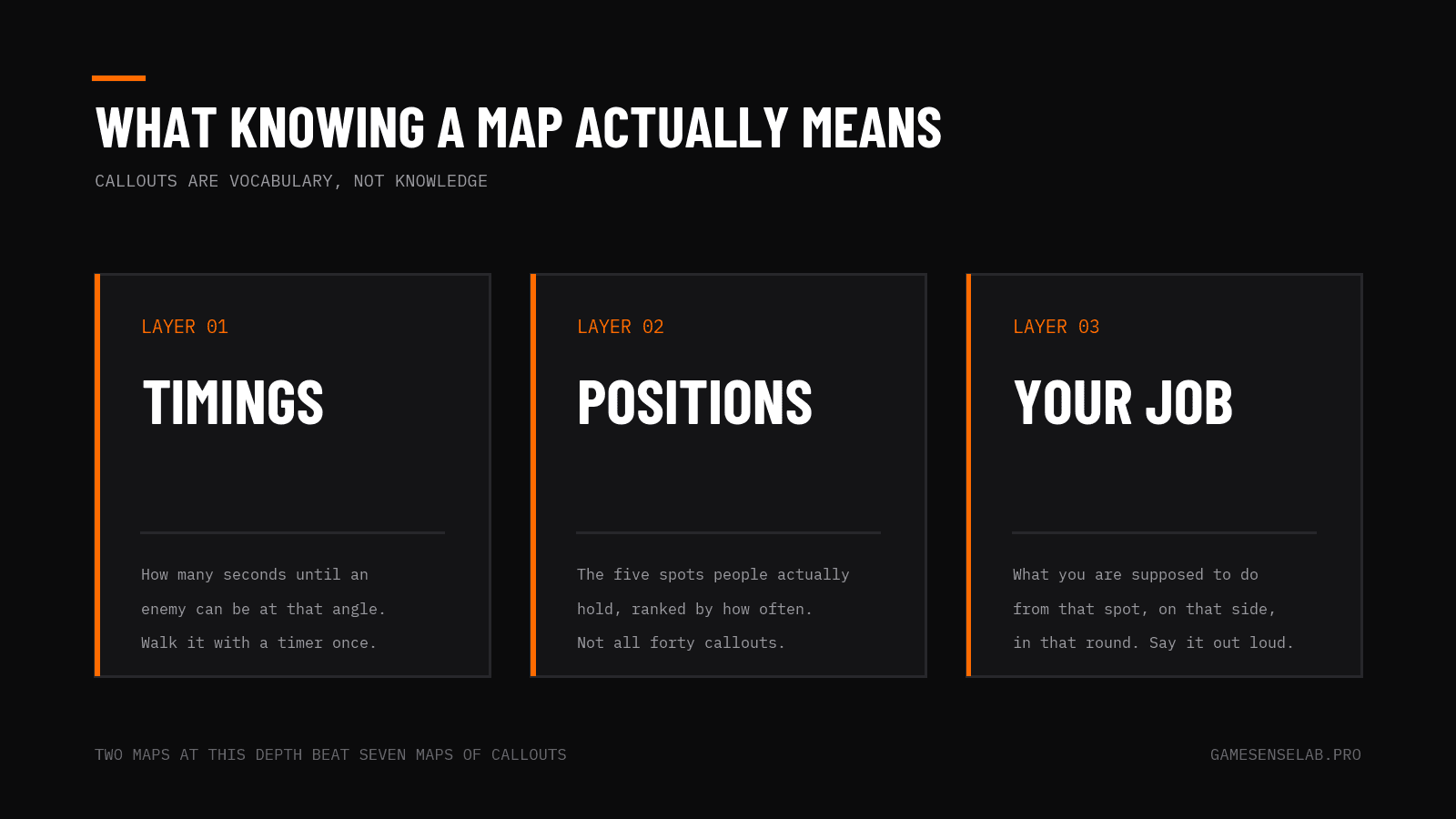
Two maps at this depth beat seven maps of callouts.
Timings. How many seconds until an enemy can be standing at the angle you are about to walk into. This is the layer that stops you dying to the same opening duel forty times. You learn it by walking the map once with a stopwatch: spawn, walk the route, note the number. Do it for the four or five routes that matter and you will never again peek mid at eight seconds thinking you are early.
Positions. Not all forty callouts. The five spots people actually hold, ranked by how often they are held. On any map, the majority of the enemies you meet are in a handful of places, and they are there because those places are good. Learn those five and you have pre-aimed most of the round before it starts.
Your job. What you are supposed to be doing from that spot, on that side, in that round. This is the layer nobody teaches, and it is the one that separates a Level 5 from a Level 8. The Level 5 is at a position. The Level 8 is at a position for a reason, and can say the reason out loud.
HOW TO LEARN ONE MAP IN A WEEK
Pick one map. Not two at once.
Day 1 — callouts. Twenty minutes in an offline server with bot_kick. Walk the whole map, look up the callout map once, say the names out loud as you walk. Done, never revisit.
Day 2 — timings. Offline again. Walk the five main routes from both spawns, time each one. Write the numbers somewhere. This is the highest-value twenty minutes you will spend on any map.
Day 3 — positions. Watch one professional demo on that map. Not for the highlights — pause at the start of each round and note where the CTs are standing. After ten rounds you will see the same five positions repeating.
Day 4 — utility. Three lineups, as covered in the utility guide: one smoke for the main choke, one molotov for the most-held spot, one pop flash for your usual entry.
Day 5 to 7 — play it. Only that map. After each game, write one sentence: what killed me most today. That sentence is your next week.
THE BAN IS PART OF THE SKILL
In Premier you veto maps before every game, and most players click through it without thinking.
If you have two strong maps, the veto is where you win rounds before the game starts. Ban the two maps you are worst at, every single time, without discussion. You are not being narrow-minded, you are refusing to play a game you have already lost.
Players who veto "whatever" and then complain about being bad on Nuke have chosen to be bad on Nuke.
THE FOUR MISTAKES
Learning callouts and calling it map knowledge. Callouts are day one of seven.
Queueing whatever comes up. Random maps give you random reps, which is the same as no reps.
Watching pro demos for the fragging. Pause at round start and look at where people are standing. That is where the information is.
Adding a third map too early. You add a third when you can say your job out loud, on both sides, on the first two. Not before.
WHEN TO ADD A THIRD
The signal is simple. On your two maps, can you say — before the round starts — what you are doing, where you are going, and what you do if the first plan fails?
If yes on both maps and both sides, add a third. If not, the third map will just be a third place to be confused.
Most players who feel stuck at Level 5 are trying to be adequate on seven maps. The ones who climb out are usually very good on two.
WHERE MAP KNOWLEDGE FITS
Map knowledge is the layer that makes everything else cheaper. Good movement wins the duel you are in. Map knowledge decides whether you take that duel at all, and whether you take it from the good side of the angle.
It is also the layer that pays back the longest. Aim decays if you stop playing. A map you properly learned is still there a year later.
If you are grinding and nothing is moving, the problem is rarely one skill. Here is how the layers stack, and where map knowledge sits inside them.

Brian Sirbu
CS2 COACH // GAMESENSELAB
MORE CS2 GUIDES


