/
/
Aim
Aim
The Best CS2 Prefire Maps — And How to Actually Train With Them
Prefire maps teach you where people stand. They do not teach you when to peek. Here are the maps worth installing and how to run a session that transfers.
WHAT YOU’LL LEARN

Prefire maps are the most downloaded and most misused training maps in Counter-Strike.
The appeal is obvious: bots stand where real players stand, you clear a route, you get better at clearing that route. It feels like practising the actual game instead of shooting floating heads.
It works, but only if you use it for what it actually trains. Most players run prefire maps like an aim trainer and wonder why nothing changes in their matches.
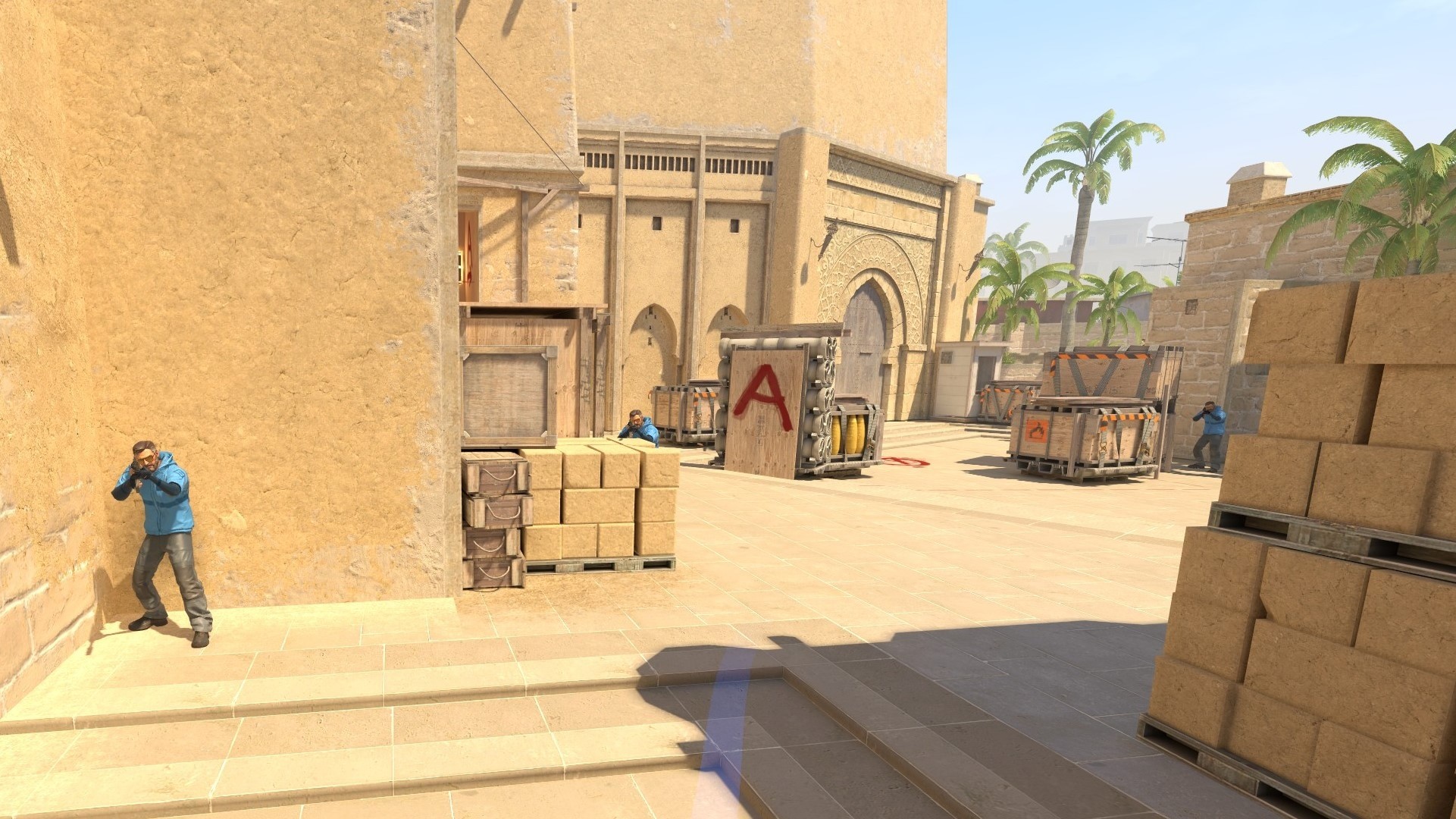
Bots spawn where real players hold. That is the whole idea.
WHAT A PREFIRE MAP ACTUALLY TRAINS
A prefire map does one thing well: it burns the common holding positions of a map into your memory, and teaches your crosshair to arrive there before your eyes do.
That is worth a lot. At every rank below Level 8, a large share of opening duels are lost because the attacker's crosshair was at the floor, or at the wrong half of the doorway, when the angle opened.
Here is what a prefire map does not train, and this is the part nobody says out loud:
It does not train timing. The bot is always there. A real player might have rotated, might be stacked, might have already pushed past you.
It does not train information. In a real round you know something before you peek — a sound, a teammate's call, a trade that already happened. On a prefire map you know everything, always.
It does not train restraint. The map rewards clearing every angle fast. Real rounds often reward not taking the fight at all.
So a prefire map makes your mechanics match the map's geometry. It does not make you a better decision-maker, and if you treat it as if it does, you end up as a player who prefires confidently into situations he should have avoided.
THE TWO SETUPS WORTH INSTALLING
There are dozens of prefire maps. You need one of these two approaches, not both.
Option 1 — Yprac Hub (everything in one addon)
The Yprac series has been the standard in Counter-Strike practice for years, and the CS2 version puts every mode into a single addon: prefire with 64+ routes, an aim trainer, 1400+ utility lineups, and shortcut practice, across all the official competitive maps.
Just over a million players currently have it installed, and it was last updated in September 2026, which matters more than it sounds — a lot of CS2 workshop maps were abandoned after release and no longer match the current map versions.
Install it if you want one thing that covers everything and you are happy to navigate a menu to get to the mode you want.
Open it in the Workshop: https://steamcommunity.com/sharedfiles/filedetails/?id=3070715607
Option 2 — The lmtlss prefire series (one map per map)
The alternative is a separate, dedicated prefire map for each competitive map, made by lmtlss. Each one spawns bots across the real holding positions of that map, with adjustable difficulty, adjustable bot count, and route selection.
Install these if you play one or two maps seriously and want to load straight into prefire practice on them without going through a hub menu.
Mirage: https://steamcommunity.com/sharedfiles/filedetails/?id=3267302800
Dust 2: https://steamcommunity.com/sharedfiles/filedetails/?id=3295650711
Inferno: https://steamcommunity.com/sharedfiles/filedetails/?id=3289507717
Nuke: https://steamcommunity.com/sharedfiles/filedetails/?id=3318295422
Ancient: https://steamcommunity.com/sharedfiles/filedetails/?id=3282067356
Anubis: https://steamcommunity.com/sharedfiles/filedetails/?id=3307639951
Overpass: https://steamcommunity.com/sharedfiles/filedetails/?id=3328383138
Vertigo: https://steamcommunity.com/sharedfiles/filedetails/?id=3274138705
To install any of them, open the link, press Subscribe, then launch CS2, go to Play, switch the game mode dropdown to Workshop Maps, and pick it from the list.
HOW TO RUN A SESSION THAT TRANSFERS
Fifteen minutes, three passes, one map. Not forty minutes of clearing routes on autopilot.
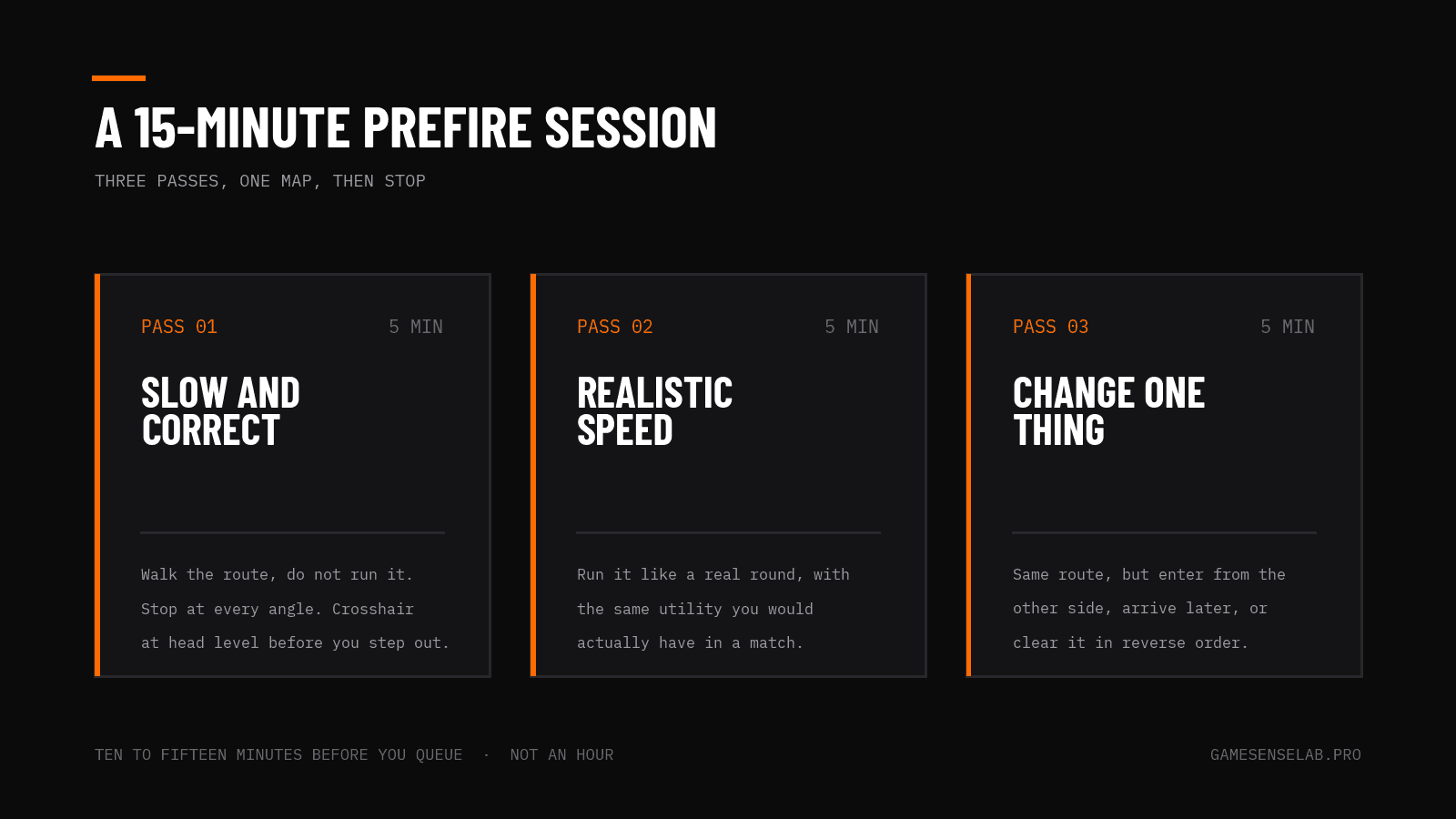
Fifteen minutes, three passes. Not forty minutes on autopilot.
Pass 1 — slow and correct, 5 minutes. Walk the route. Do not run it. Stop at every angle, place your crosshair where a head would be, and only then step out. You are teaching your hands where the positions are. Speed at this stage teaches you nothing except bad habits faster.
Pass 2 — realistic speed, 5 minutes. Now run it the way you would in a real round, with the same utility you would actually have. If you would smoke an angle in a match, smoke it here. If you would flash before the corner, flash. A route you clear without utility on a prefire map is a route you will die on in a real one.
Pass 3 — one variable changed, 5 minutes. Take the same route and change one thing: enter from the other side, arrive ten seconds later, or clear it in the reverse order. This is the pass that stops prefire practice turning into a dance you can only perform one way.
Then stop. Prefire is a warm-up skill, not a session. Ten to fifteen minutes before you queue is the right dose; an hour of it is an hour you did not spend on the thing that is actually holding you back.
THE MISTAKE ALMOST EVERYONE MAKES
You get good at the map, not at the game.
After two weeks of Mirage prefire, you can clear A site in eleven seconds with perfect crosshair placement. Then you play a real match, take the same route at the same speed, and die to someone holding from a position the bot never used — or worse, to a player who heard you coming because you took the same route the round before.
Prefire maps teach a route. Matches punish predictability.
The fix is the third pass above, and one rule in real games: never run the exact same entry twice in a half. The value of prefire practice is that your crosshair goes to head level automatically. The value is not the route itself.
WHICH MAP TO START WITH
Start with the map you already play most, not the one you are worst at.
Prefire practice compounds with map knowledge you already have. On a map you know, the positions have context — you know which of them actually get held at 0:30 and which are rare. On a map you barely play, you are memorising a list of spots with no idea which ones matter.
If you play everything equally, start with Mirage. It has the most consistent holding positions across ranks, so what you learn there transfers most reliably.
PREFIRE IS ONE LAYER OF MAP KNOWLEDGE
Here is the honest limit of everything above.
Prefire practice teaches you where people stand. Real map knowledge is knowing when they stand there, what it means when they do not, and where they go next. That is the difference between a player who clears angles well and a player who wins rounds.
You cannot get that from a workshop map, because a workshop map has no round timer, no economy, no teammates and no consequences.
That layer is exactly what the Map Playbook inside the Rank Up Society covers: for every competitive map, the positions worth holding, when each one is actually contested, how rotations work when mid is lost, and what your job is depending on the role you are playing that round. Written out, map by map, instead of scattered across forty YouTube videos.
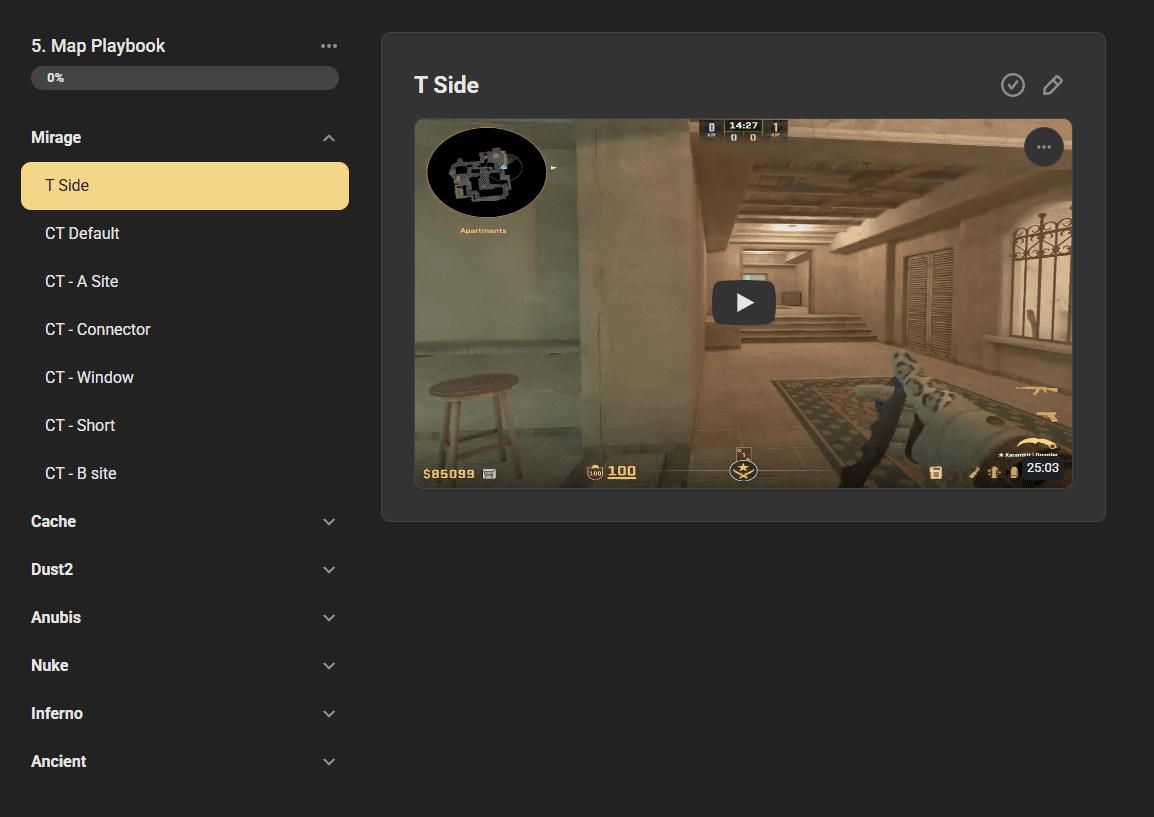
Every map, every position, every rotation — written out.
Prefire maps get your crosshair to the right place. The playbook tells you whether you should have been there at all.
WHERE TO ACTUALLY JOIN
The Rank Up Society is hosted on Skool. Eight modules in the order they actually work, recorded live demo reviews, and a questions channel where you can describe your own situation instead of guessing which guide applies to you.
Five dollars a month, cancel any time. Join the CS2 Rank Up Society here.
If you are not ready to pay for anything, the Discord is free and the questions channel is open. Join the Discord here.
And if prefiring is not actually your problem, this is the six-layer system that tells you what is.

Brian Sirbu
CS2 COACH // GAMESENSELAB
MORE CS2 GUIDES


