/
/
Ranking Up
Ranking Up
Stuck at FACEIT Level 5? The Real Reason You Are Not Climbing
Level 5 holds more CS2 players than any other rank. Here is what actually changes between Level 4 and Level 7, and how to find which wall is yours.
WHAT YOU’LL LEARN

There are about 1.9 million ranked CS2 players on FACEIT. More of them sit at Level 5 than at any other level — roughly one in seven.
That is not a coincidence, and it is not bad luck. Level 5 is where the thing that got you here stops working, and most players respond by doing more of it.

Level 5 is the biggest traffic jam in the game.
WHAT LEVEL 5 ACTUALLY IS
Level 5 is 1051 to 1200 Elo. You start at 1000 after placements, which puts you at Level 4. So Level 5 is, for most players, the first level they earn rather than receive.
That matters. Getting from 1000 to 1100 takes almost nothing: aim slightly better than average and the Elo arrives. Getting from 1100 to 1350 takes something completely different, and nobody tells you when the switch happens.
Below Level 5, games are decided by who can shoot. At Level 5, everyone can shoot well enough. The games start being decided by who wastes fewer rounds.
THE FOUR WALLS
Almost every player stuck at Level 5 is stuck behind one of four things. Not all four. One. Read them and find the one that makes you uncomfortable.
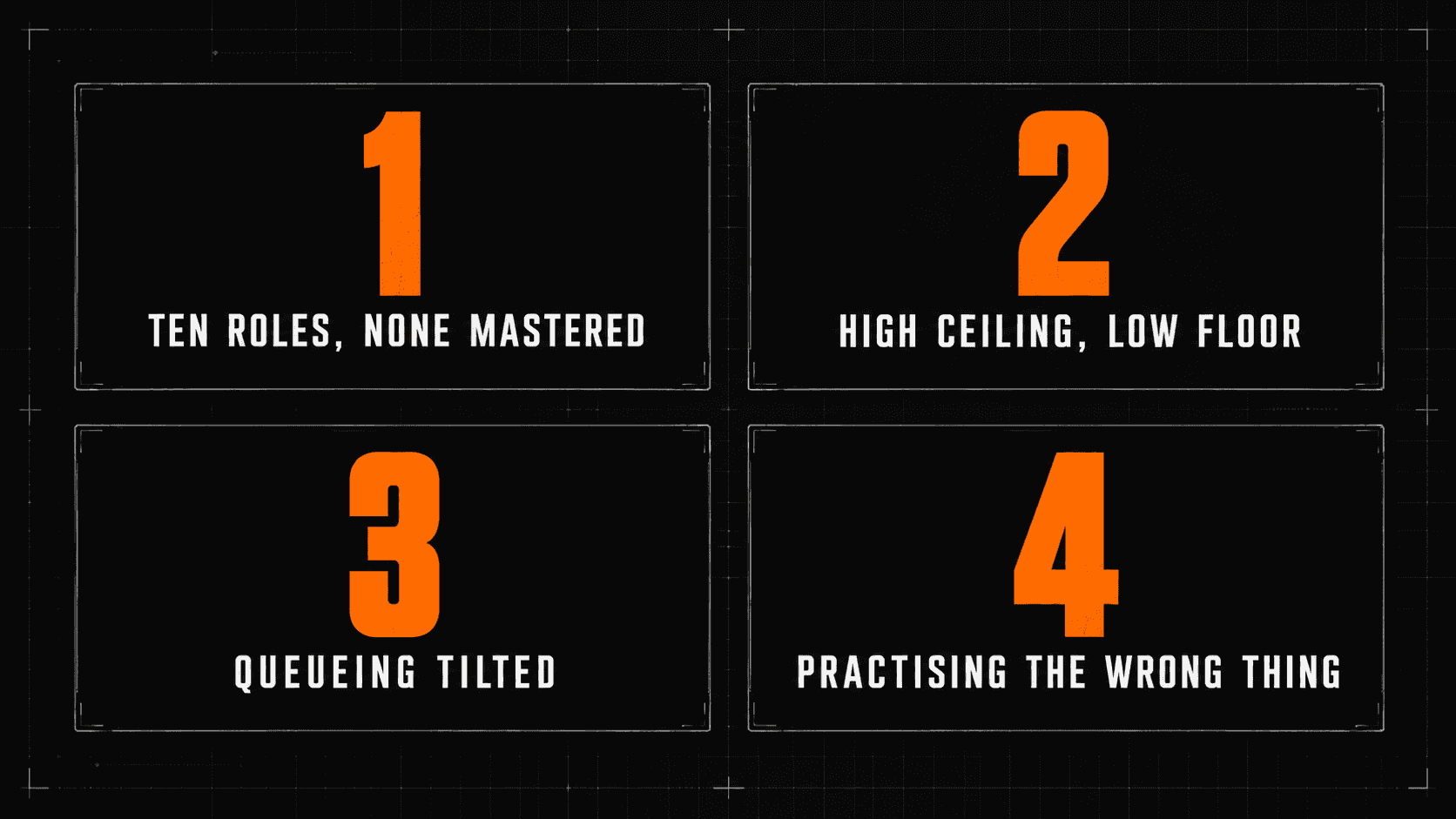
One of these is yours. Only one.
WALL 1 — YOU PLAY TEN ROLES BADLY INSTEAD OF TWO WELL
What it looks like. You entry sometimes. You AWP sometimes. You lurk when nobody else does. You anchor B because nobody called it. Every match you play a different game.
Why it stops you. Skill compounds inside a role. A player who has entried A site on Mirage four hundred times knows things you cannot learn in four hundred matches of playing whatever is left over. You are spreading the same hours across five skill curves and climbing none of them.
The fix. Pick two roles. One on T side, one on CT side. Play them in every match for a month, even when the team composition is awkward. You will lose some rounds to inflexibility and gain far more to depth.
WALL 2 — YOUR CEILING IS FINE, YOUR FLOOR IS TERRIBLE
What it looks like. Your best games are Level 8 games. Your worst games are Level 2 games. You describe yourself as inconsistent and you are right.
Why it stops you. Elo is not an average of your best matches. A 25-kill game and a 7-kill game cancel out, and the 7-kill game costs your team a round of tilt as well. Climbing is not about raising your peak. It is about deleting your worst nights.
The fix. Find what your bad games have in common. It is almost never aim. It is usually one of three things: you were tilted, you were tired, or you were playing a map you never learned. All three are scheduling problems, not skill problems.
WALL 3 — YOU QUEUE IN STATES YOU SHOULD NOT QUEUE IN
What it looks like. Two losses, then a third match immediately. A 2am queue after work. A solo queue on a map you dislike because you did not want to wait.
Why it stops you. Elo you lose while tilted is not recoverable by playing better later — it is the same Elo, and you have to win it back against players who are not tilted. Most Level 5 players are not stuck because they cannot play at 1300. They are stuck because they spend their good sessions climbing to 1250 and their bad sessions giving it all back.
The fix. Two losses in a row ends the session. No exceptions, no "one more to end on a win". That single rule moves more players off Level 5 than any aim routine.
WALL 4 — YOU PRACTICE WHAT IS MEASURABLE, NOT WHAT IS BROKEN
What it looks like. You warm up on aim maps every day. Your spray is clean. Your crosshair placement is fine. You are still at 1100.
Why it stops you. Mechanics are easy to practise because they give you a number back. Decision-making does not. So players who are already mechanically adequate keep polishing the thing that is not the problem, because it feels like work and the alternative feels vague.
The fix. Stop practising mechanics for one month unless a demo tells you mechanics are the issue. If they genuinely are, the training maps worth using are here. If they are not, that month goes into demo review instead.
HOW TO FIND WHICH WALL IS YOURS
You cannot pick your wall by reading. You will pick the one that sounds most flattering. Use your last five matches instead.
Open your FACEIT match history and write down five numbers: kills, deaths, map, time of day, and whether you had already lost that session. Do it for five matches, not one.
Then look:
If the maps and roles are all different, it is Wall 1.
If two matches look nothing like the other three, it is Wall 2.
If the bad ones cluster at the end of sessions or late at night, it is Wall 3.
If nothing stands out and your stats are simply flat, it is Wall 4 — and a demo will tell you the rest. Here is the routine.
THE THREE-WEEK PLAN

Three weeks, one wall, one sentence.
Week 1 — diagnose and stop the bleeding. Run the five-match check above. Apply the two-loss rule starting immediately, whatever your wall is. Do not change anything else. Most players gain 30 to 50 Elo from this alone, not because they improved, but because they stopped donating.
Week 2 — fix one thing. Take the wall you found and apply its one fix. One. Write it as a single sentence and read it before every match. If it is Wall 1, that sentence names your two roles. If it is Wall 2, it names the condition you will not queue in.
Week 3 — check whether the pattern shrank. Review one demo at the end of the week and look for the same problem. Not for new problems, which you will always find. For that one. If it appears less often, keep going. If it appears just as much, your fix was too vague — make it smaller and more specific.
Three weeks is not enough to reach Level 7. It is enough to know whether you are moving, which is more than most players stuck at Level 5 can say after six months.
THE PART YOU CANNOT DO ALONE
Three of the four walls you can fix by yourself with a notebook and some discipline.
Wall 4 is the one that resists. You cannot see your own decisions while you are making them — they feel like normal choices from the inside, which is exactly why they have survived two thousand hours. Watching your own demo helps, but you are still the person grading your own homework.
That is the gap the Rank Up Society was built for. Recorded live demo reviews where you watch someone else's round get taken apart and recognise yourself in it. A questions channel where you can describe your specific situation instead of guessing which YouTube video applies to you. And players one or two levels above you who were at 1100 recently enough to remember what got them out.

Recorded demo reviews you can rewatch whenever you want.
WHAT NOT TO DO
Do not buy a boost. You will be placed in Level 7 lobbies playing like a Level 5 player, lose 200 Elo in a week, and learn nothing except that the games are harder.
Do not change your settings again. Sensitivity, crosshair and resolution are not why you are at 1100. Changing them resets the only thing you had going for you, which is muscle memory.
If you have never actually checked where your sensitivity sits, run it through the eDPI calculator once and then leave it alone.
Do not track your Elo daily. It moves 20 to 50 points a match and means nothing across five matches. Look at it every two weeks or not at all.
Do not try to fix all four walls. You will hold four rules in your head, play worse than before you read this article, and conclude that none of it works. Pick one. The habits that quietly cost you rounds are worth reading next, but read them after you have fixed the wall, not instead of it.
WHERE TO ACTUALLY JOIN
Everything above is layer five of a six-layer system. If you want to see where it fits and what comes before and after it, here is the whole thing.
The Rank Up Society is hosted on Skool. Eight modules in order, recorded live sessions, and a questions channel where you can ask about your own situation. Five dollars a month, cancel any time. Join the CS2 Rank Up Society here.
If you are not ready to pay for anything, the Discord is free and the questions channel is open. Join the Discord here.

Brian Sirbu
CS2 COACH // GAMESENSELAB
MORE CS2 GUIDES


